Rapid incident response within 72 hours is mandatory for GDPR compliance, with fines reaching €110 million for violations
Account takeover attacks surged 250% year-over-year in 2024, with 99% of organizations targeted and 62% experiencing successful breaches. As cybercriminals deploy increasingly sophisticated methods—from AI-powered deepfakes to massive credential stuffing campaigns—security teams face an unprecedented challenge in protecting user accounts across their digital infrastructure.
The financial impact alone demands immediate attention. Account takeover fraud resulted in $2.77 billion in business email compromise losses reported to the FBI in 2024, while organizations grapple with regulatory fines reaching €110 million for inadequate account security measures. For security analysts, SOC leaders, and CISOs, understanding and defending against account takeover has become mission-critical.
This comprehensive guide examines the current account takeover threat landscape, breaking down attack methods, detection strategies, and prevention technologies. You'll learn how to implement effective defenses against both traditional and emerging AI-powered attacks while meeting compliance requirements and maintaining user productivity.
What is account takeover?
Account takeover is a form of identity theft where cybercriminals gain unauthorized access to user accounts through stolen credentials, session hijacking, or social engineering, then use that access to commit fraud, steal data, or launch further attacks within an organization's network. Unlike simple credential theft, account takeover encompasses the complete compromise and control of legitimate user accounts, enabling attackers to operate undetected while appearing as trusted users.
The distinction between account takeover and related threats matters for defense strategies. While credential theft involves obtaining usernames and passwords, account takeover represents the successful exploitation of those credentials to gain persistent access. Identity theft broadly encompasses personal information misuse, but account takeover specifically targets online accounts for immediate exploitation. This operational control enables attackers to bypass security controls, access sensitive systems, and maintain persistence even after password resets.
Modern account takeover attacks have evolved far beyond simple password theft. The integration of artificial intelligence has transformed the threat landscape, with deepfake fraud attempts increasing 2,137% over three years—now accounting for 6.5% of all fraud attempts. These AI-powered attacks can bypass biometric authentication, manipulate voice verification systems, and create synthetic identities that appear legitimate to traditional security controls.
What makes account takeover different from other identity attacks?
Account takeover is often confused with credential theft or broader identity theft, but it represents a more advanced and more dangerous stage of compromise. The critical difference is not how credentials are obtained, but what attackers can do once access is achieved.
Understanding this distinction clarifies how account takeover differs from other identity-related threats and why it carries significantly higher risk:
Credential theft focuses on stealing usernames and passwords, often at scale, without necessarily using them immediately.
Identity theft broadly involves the misuse of personal, financial, or identifying information for fraud.
Account takeover occurs when stolen credentials or session tokens are actively used to gain persistent, trusted access to legitimate user accounts.
As a result, account takeover is not just an identity issue, it is an access and trust problem. Once attackers control a valid account, they can bypass MFA, evade perimeter defenses, and maintain access even after passwords are reset, especially when sessions, tokens, or recovery mechanisms are also compromised.
Common account takeover scenarios
Account takeover does not follow a single pattern. In practice, it appears differently depending on the target, access level, and business context. Below are the most common ways account takeover manifests in real-world attacks:
Customer account takeover
Attackers compromise consumer or customer-facing accounts using stolen credentials, phishing, or malware-derived session tokens. Once inside, they perform fraudulent transactions, change account details, or monetize stored payment methods and loyalty points. These attacks often scale quickly, affecting thousands of users before detection, and result in direct financial loss and reputational damage.
These accounts are frequently resold or reused to commit additional fraud across other platforms.
Enterprise SaaS and SSO compromise
Single sign-on (SSO) and SaaS platforms are high-value targets because one compromised account can unlock access to email, file storage, CRM systems, and internal applications. Attackers use credential stuffing, OAuth abuse, or token theft to gain entry, then move laterally across cloud services while appearing as legitimate users. Detection is difficult because activity originates from valid identities using approved tools.
Executive and finance impersonation
High-privilege accounts belonging to executives, finance leaders, or IT administrators are targeted for maximum impact. Attackers leverage phishing or AI-powered social engineering to gain access, then initiate wire transfers, modify vendor payment details, or authorize fraudulent transactions. These attacks often bypass traditional controls by exploiting trust, urgency, and delegated authority rather than technical vulnerabilities alone.
Session-based persistence attacks
In some cases, attackers do not rely on passwords at all. By stealing active session cookies or authentication tokens, they maintain access even after credentials are reset or MFA is re-enabled. This persistence allows attackers to return repeatedly, evade remediation efforts, and quietly escalate privileges over time.
Third-party and vendor account abuse
Attackers compromise partner, contractor, or service-provider accounts that have legitimate access into internal systems. Because these accounts are expected to connect remotely and often have broad permissions, malicious activity blends into normal traffic. This scenario is especially dangerous in supply-chain environments, where a single vendor compromise can impact dozens or hundreds of downstream organizations.
How AI is changing account takeover attacks
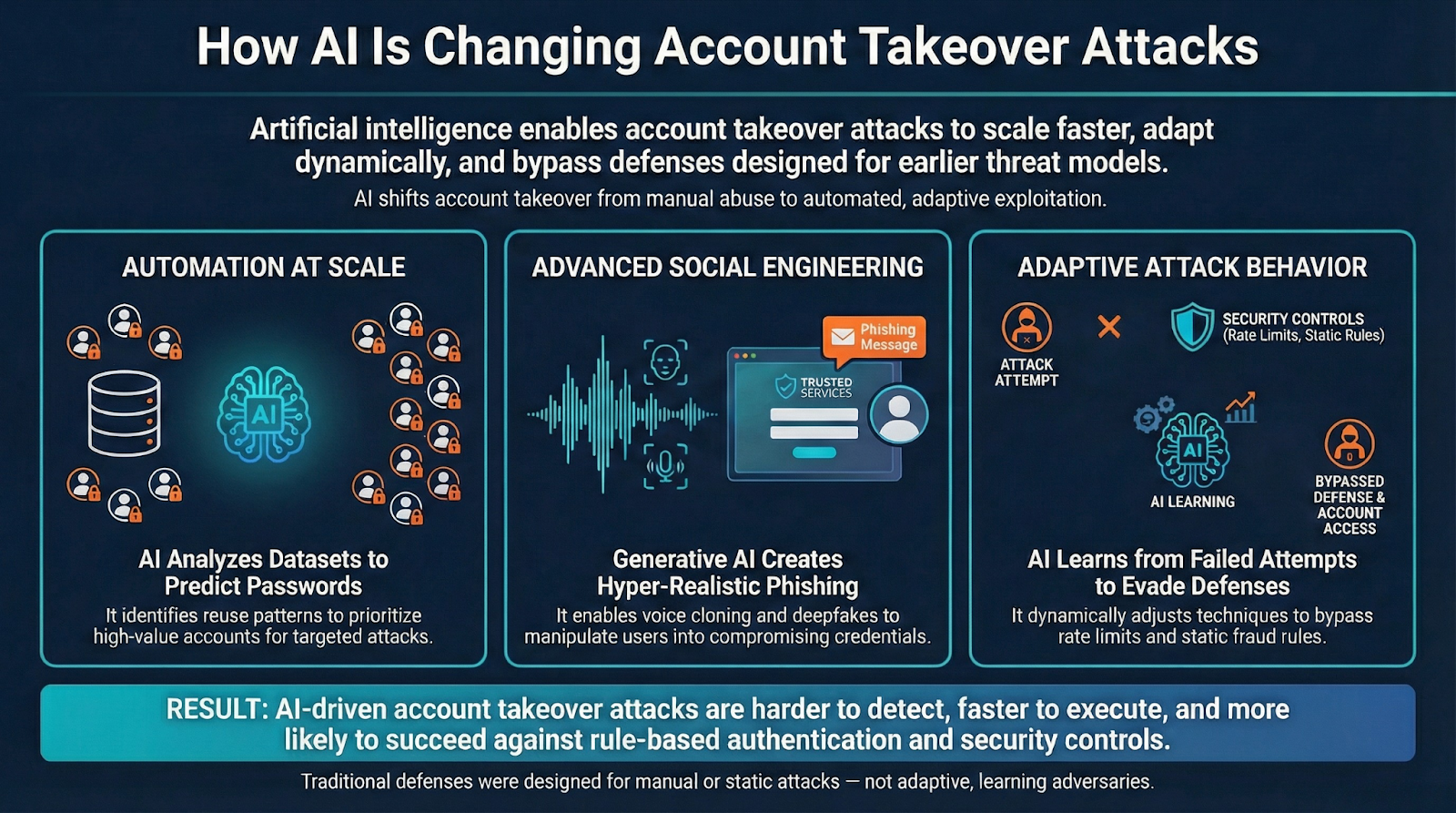
Artificial intelligence has fundamentally altered how account takeover attacks are executed, scaled, and optimized. Rather than relying on manual phishing or basic brute-force techniques, attackers now use AI to automate decision-making, personalize attacks in real time, and bypass controls designed for earlier threat models.
AI-driven account takeover differs from traditional attacks in three core ways:
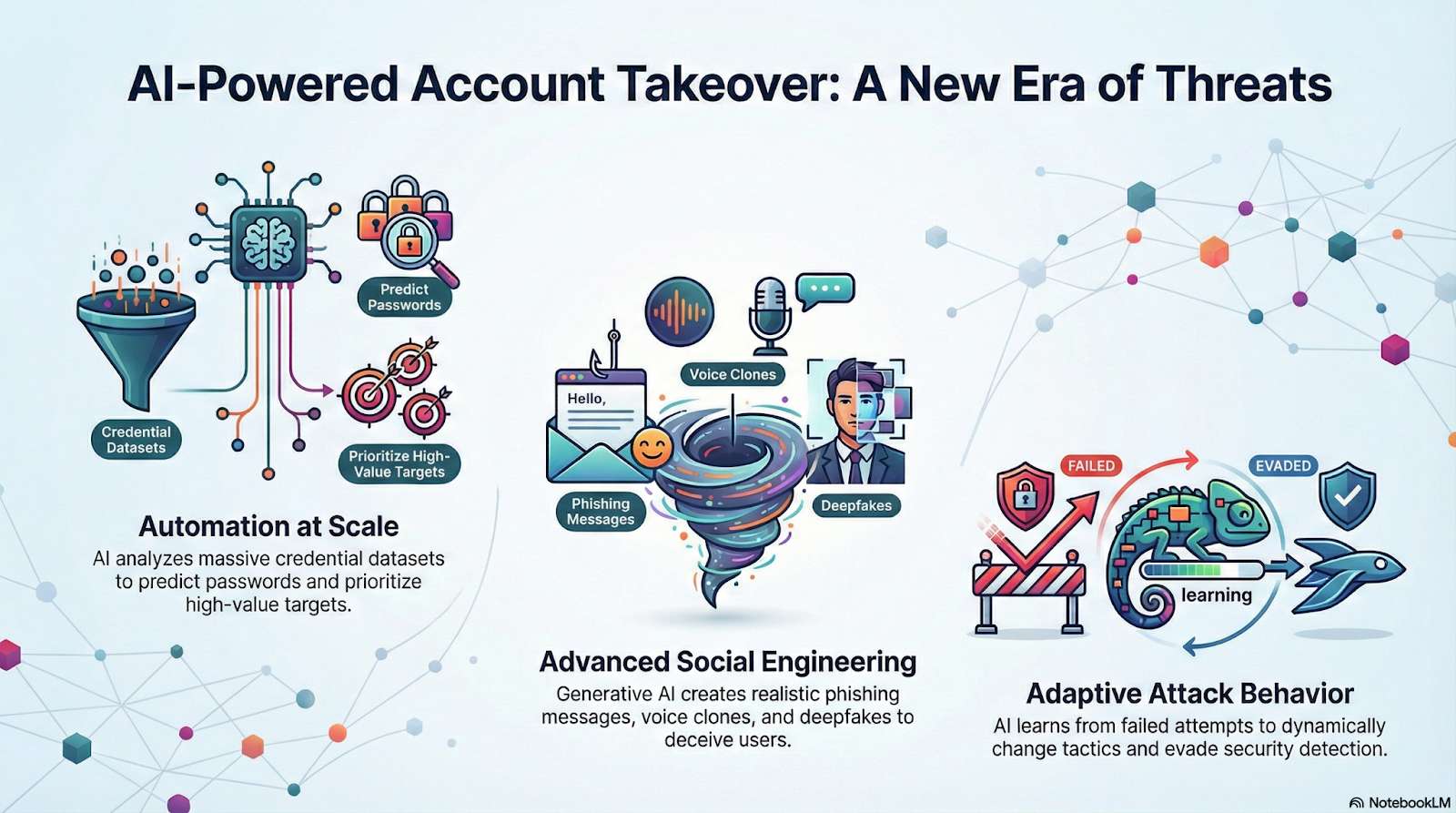
Automation at scale enables attackers to analyze large credential datasets, detect reuse patterns, and prioritize high-value accounts, replacing random login attempts with data-driven targeting.
Advanced social engineering leverages generative AI to create realistic phishing content, voice cloning, and deepfake impersonation, increasing attacker credibility and bypassing MFA through human manipulation rather than technical flaws.
Adaptive attack behavior allows AI-powered tools to learn from blocked attempts and user responses, continuously adjusting timing, delivery, and targets to evade rate limits and static detection rules.
Because of these capabilities, AI-driven account takeover attacks are faster, more targeted, and significantly harder to detect than traditional, rule-based attack methods.
Why traditional MFA fails against AI-driven account takeover
Multi-factor authentication remains an essential security control, but it is no longer sufficient on its own to stop modern account takeover attacks. AI-powered attackers increasingly bypass MFA not by breaking it technically, but by exploiting how and when it is used.
Traditional MFA fails in several common scenarios:
Real-time social engineering allows attackers to trick users into approving push notifications, sharing one-time passcodes, or completing authentication during live interactions such as phone calls or video meetings.
Session and token theft enables attackers to bypass MFA entirely by hijacking authenticated sessions, stolen cookies, or OAuth tokens that remain valid even after a user successfully completes MFA.
MFA fatigue and push abuse exploits human behavior by flooding users with authentication requests until one is accidentally approved, especially during high-pressure or distracting moments.
Trusted device and recovery weaknesses occur when attackers register new devices, abuse password reset flows, or compromise account recovery mechanisms that are not protected by strong MFA controls.
As a result, MFA often stops automated attacks but fails against targeted, adaptive campaigns that blend technical abuse with human manipulation.
How account takeover attacks work
Account takeover attacks follow a predictable kill chain that begins with reconnaissance and credential acquisition, progresses through initial access and privilege escalation, and culminates in data exfiltration or fraud. Understanding this progression allows security teams to apply targeted controls at each stage and disrupt attacks before meaningful damage occurs.
In practice, attackers rely on a small number of high-impact techniques:
Credential stuffing exploits the 72% of users who reuse passwords across multiple sites. Attackers automate login attempts using billions of username-password combinations from previous data breaches, achieving success rates of 0.1–2% at scale. Tools like TeamFiltration automated this process during the Microsoft Entra ID campaign, testing credentials across 80,000 corporate accounts with a 12% success rate.
Phishing attacks now extend beyond generic email scams to highly targeted spear-phishing. Attackers research individuals through social media, craft convincing pretexts, and deploy credential-harvesting pages that mirror legitimate login portals. These campaigns often bypass email filters by abusing trusted platforms such as Microsoft 365 or Google Workspace.
Session hijacking enables access without credentials by stealing or manipulating session tokens. Techniques include cross-site scripting (XSS), man-in-the-middle interception, and session fixation. Once valid tokens are obtained, attackers can retain access even after password resets, as seen in campaigns where stolen cookies survived security resets.
Malwareand infostealers operate at industrial scale, silently harvesting credentials, session cookies, and authentication tokens from infected devices. The 2.1 billion credentials stolen by infostealers in 2024 continue to fuel credential stuffing and account takeover campaigns, creating a self-reinforcing cycle of compromise.
Account takeover prevention
Preventing account takeover requires security controls that assume credentials, tokens, or sessions will eventually be compromised and focus on limiting attacker success after initial access, not just at the point of login.
Behavioral monitoring detects early signs of account misuse by analyzing login patterns, sessions, devices, and privilege changes.
Session and token protection limits persistence by securing cookies, OAuth tokens, and API credentials after authentication.
Rate limiting and abuse detection reduce the effectiveness of automated attacks such as credential stuffing and password spraying.
Continuous verification and zero-trust controls restrict lateral movement and reduce blast radius once an account is compromised.
AI-powered account takeover
Rather than trying to stop every compromise, effective prevention focuses on detecting misuse of access quickly and reducing its impact.
What makes account takeover different from other identity attacks?
Account takeover is often confused with credential theft or broader identity theft, but it represents a more advanced and more dangerous stage of compromise. The critical difference is not how credentials are obtained, but what attackers can do once access is achieved.
Understanding this distinction clarifies how account takeover differs from other identity-related threats and why it carries significantly higher risk:
Credential theft focuses on stealing usernames and passwords, often at scale, without necessarily using them immediately.
Identity theft broadly involves the misuse of personal, financial, or identifying information for fraud.
Account takeover occurs when stolen credentials or session tokens are actively used to gain persistent, trusted access to legitimate user accounts.
As a result, account takeover is not just an identity issue, it is an access and trust problem. Once attackers control a valid account, they can bypass MFA, evade perimeter defenses, and maintain access even after passwords are reset, especially when sessions, tokens, or recovery mechanisms are also compromised.
The rising threat of AI-powered account takeover
Artificial intelligence has democratized sophisticated attack techniques previously available only to nation-state actors. Deepfake technology now enables attackers to impersonate executives in video calls, as demonstrated in the Arup engineering firm incident where criminals used real-time voice and video manipulation to steal $25 million during a single conference call. The accessibility of these tools means any motivated attacker can launch AI-enhanced account takeover campaigns.
The Discord/Zendesk breach in October 2025 exemplifies this evolution, where attackers compromised third-party vendor access to expose over 70,000 government-issued IDs. By manipulating OAuth tokens and bypassing MFA through AI-powered social engineering, criminals demonstrated how traditional security controls fail against modern attack methods. Organizations must now defend against threats that combine technical exploitation with convincing synthetic media designed to fool both humans and machines.
The scope of AI-enhanced attacks extends beyond deepfakes. Machine learning algorithms analyze millions of breached credentials to identify patterns, automate password variations, and predict user behavior. These capabilities enable attackers to execute targeted campaigns at scale, with success rates significantly higher than traditional brute-force methods. As identity threat detection and response becomes more critical, security teams need advanced analytics to counter AI-powered threats.
Common account takeover scenarios
Account takeover does not follow a single pattern. In practice, it appears differently depending on the target, access level, and business context. Below are the most common ways account takeover manifests in real-world attacks:
Customer account takeover
Attackers compromise consumer or customer-facing accounts using stolen credentials, phishing, or malware-derived session tokens. Once inside, they perform fraudulent transactions, change account details, or monetize stored payment methods and loyalty points. These attacks often scale quickly, affecting thousands of users before detection, and result in direct financial loss and reputational damage.
These accounts are frequently resold or reused to commit additional fraud across other platforms.
Enterprise SaaS and SSO compromise
Single sign-on (SSO) and SaaS platforms are high-value targets because one compromised account can unlock access to email, file storage, CRM systems, and internal applications. Attackers use credential stuffing, OAuth abuse, or token theft to gain entry, then move laterally across cloud services while appearing as legitimate users. Detection is difficult because activity originates from valid identities using approved tools.
Executive and finance impersonation
High-privilege accounts belonging to executives, finance leaders, or IT administrators are targeted for maximum impact. Attackers leverage phishing or AI-powered social engineering to gain access, then initiate wire transfers, modify vendor payment details, or authorize fraudulent transactions. These attacks often bypass traditional controls by exploiting trust, urgency, and delegated authority rather than technical vulnerabilities alone.
Session-based persistence attacks
In some cases, attackers do not rely on passwords at all. By stealing active session cookies or authentication tokens, they maintain access even after credentials are reset or MFA is re-enabled. This persistence allows attackers to return repeatedly, evade remediation efforts, and quietly escalate privileges over time.
Third-party and vendor account abuse
Attackers compromise partner, contractor, or service-provider accounts that have legitimate access into internal systems. Because these accounts are expected to connect remotely and often have broad permissions, malicious activity blends into normal traffic. This scenario is especially dangerous in supply-chain environments, where a single vendor compromise can impact dozens or hundreds of downstream organizations.
How AI is changing account takeover attacks
Artificial intelligence has fundamentally altered how account takeover attacks are executed, scaled, and optimized. Rather than relying on manual phishing or basic brute-force techniques, attackers now use AI to automate decision-making, personalize attacks in real time, and bypass controls designed for earlier threat models.
AI-driven account takeover differs from traditional attacks in three core ways:
Automation at scale enables attackers to analyze large credential datasets, detect reuse patterns, and prioritize high-value accounts, replacing random login attempts with data-driven targeting.
Advanced social engineering leverages generative AI to create realistic phishing content, voice cloning, and deepfake impersonation, increasing attacker credibility and bypassing MFA through human manipulation rather than technical flaws.
Adaptive attack behavior allows AI-powered tools to learn from blocked attempts and user responses, continuously adjusting timing, delivery, and targets to evade rate limits and static detection rules.
Because of these capabilities, AI-driven account takeover attacks are faster, more targeted, and significantly harder to detect than traditional, rule-based attack methods.
Why traditional MFA fails against AI-driven account takeover
Multi-factor authentication remains an essential security control, but it is no longer sufficient on its own to stop modern account takeover attacks. AI-powered attackers increasingly bypass MFA not by breaking it technically, but by exploiting how and when it is used.
Traditional MFA fails in several common scenarios:
Real-time social engineering allows attackers to trick users into approving push notifications, sharing one-time passcodes, or completing authentication during live interactions such as phone calls or video meetings.
Session and token theft enables attackers to bypass MFA entirely by hijacking authenticated sessions, stolen cookies, or OAuth tokens that remain valid even after a user successfully completes MFA.
MFA fatigue and push abuse exploits human behavior by flooding users with authentication requests until one is accidentally approved, especially during high-pressure or distracting moments.
Trusted device and recovery weaknesses occur when attackers register new devices, abuse password reset flows, or compromise account recovery mechanisms that are not protected by strong MFA controls.
As a result, MFA often stops automated attacks but fails against targeted, adaptive campaigns that blend technical abuse with human manipulation.
How account takeover attacks work
Account takeover attacks follow a predictable kill chain that begins with reconnaissance and credential acquisition, progresses through initial access and privilege escalation, and culminates in data exfiltration or fraud. Understanding this progression allows security teams to apply targeted controls at each stage and disrupt attacks before meaningful damage occurs.
In practice, attackers rely on a small number of high-impact techniques:
Credential stuffing exploits the 72% of users who reuse passwords across multiple sites. Attackers automate login attempts using billions of username-password combinations from previous data breaches, achieving success rates of 0.1–2% at scale. Tools like TeamFiltration automated this process during the Microsoft Entra ID campaign, testing credentials across 80,000 corporate accounts with a 12% success rate.
Phishing attacks now extend beyond generic email scams to highly targeted spear-phishing. Attackers research individuals through social media, craft convincing pretexts, and deploy credential-harvesting pages that mirror legitimate login portals. These campaigns often bypass email filters by abusing trusted platforms such as Microsoft 365 or Google Workspace.
Session hijacking enables access without credentials by stealing or manipulating session tokens. Techniques include cross-site scripting (XSS), man-in-the-middle interception, and session fixation. Once valid tokens are obtained, attackers can retain access even after password resets, as seen in campaigns where stolen cookies survived security resets.
Malwareand infostealers operate at industrial scale, silently harvesting credentials, session cookies, and authentication tokens from infected devices. The 2.1 billion credentials stolen by infostealers in 2024 continue to fuel credential stuffing and account takeover campaigns, creating a self-reinforcing cycle of compromise.
Account takeover prevention
Preventing account takeover requires security controls that assume credentials, tokens, or sessions will eventually be compromised and focus on limiting attacker success after initial access, not just at the point of login.
Behavioral monitoring detects early signs of account misuse by analyzing login patterns, sessions, devices, and privilege changes.
Session and token protection limits persistence by securing cookies, OAuth tokens, and API credentials after authentication.
Rate limiting and abuse detection reduce the effectiveness of automated attacks such as credential stuffing and password spraying.
Continuous verification and zero-trust controls restrict lateral movement and reduce blast radius once an account is compromised.
Rather than trying to stop every compromise, effective prevention focuses on detecting misuse of access quickly and reducing its impact.
AI-enhanced attack techniques
Deepfakes and voice cloning have weaponized social engineering at scale. Attackers use AI to generate convincing audio and video impersonations of executives, IT administrators, or trusted contacts. These synthetic media bypass human verification and increasingly fool automated biometric systems. The technology has become so accessible that deepfake-as-a-service offerings appear on dark web marketplaces for as little as $500 per campaign.
Synthetic identity creation combines real and fabricated information to build digital personas that pass know-your-customer (KYC) checks. These artificial identities establish credit histories, open accounts, and build trust over months before executing attacks. Financial institutions report that 20% of new account applications now show indicators of synthetic identity fraud, representing $5 billion in annual losses.
Supply chain account compromises
The Snowflake incident affecting 165+ organizations demonstrates how supply chain compromises multiply account takeover impact. Attackers targeted a single cloud service provider to access customer environments, stealing 560 million records from Ticketmaster, data from 109 million AT&T customers, and information from 30 million Santander accounts. The attack succeeded because organizations failed to enforce MFA on service accounts, assuming vendor security controls were sufficient.
Supply chain attacks exploit trust relationships between organizations and their technology partners. Attackers compromise vendor accounts to access customer systems through legitimate channels, bypassing perimeter defenses and appearing as trusted connections. This lateral movement through partner networks makes detection extremely difficult, as malicious activity originates from expected sources using valid credentials.
Types of account takeover attacks
Account takeover attacks can be categorized by their primary attack vector, each requiring specific detection and prevention strategies. Understanding these categories helps security teams prioritize defenses based on their organization's risk profile and attack surface.
Credential-based attacks remain the most common category, encompassing credential stuffing, password spraying, and brute force attempts. Credential stuffing uses automated tools to test username-password pairs obtained from data breaches across multiple services. Password spraying reverses this approach, trying common passwords against many accounts to avoid triggering lockout policies. Brute force attacks systematically test password combinations against specific high-value accounts. These attacks succeed due to weak passwords, credential reuse, and insufficient rate limiting.
Session-based attacks manipulate or steal session identifiers to gain unauthorized access without credentials. Session hijacking intercepts active sessions through network sniffing or cross-site scripting. Session fixation forces users to authenticate with attacker-controlled session IDs. Session replay attacks reuse captured authentication tokens to impersonate legitimate users. These techniques bypass password-based security entirely, requiring token-based protections and secure session management.
Infrastructure attacks target the underlying systems and protocols that support authentication. Man-in-the-middle attacks intercept communications between users and services to steal credentials or session tokens. DNS hijacking redirects users to attacker-controlled sites that harvest credentials. BGP hijacking reroutes internet traffic to capture authentication data. These attacks require network-level monitoring and encrypted communications to detect and prevent.
Social engineering variants exploit human psychology rather than technical vulnerabilities. Phishing uses deceptive emails to direct users to credential harvesting sites. Vishing (voice phishing) uses phone calls to extract authentication codes or passwords. Smishing (SMS phishing) delivers malicious links via text message. Business email compromise combines social engineering with account takeover to initiate fraudulent wire transfers. These attacks succeed by creating urgency, impersonating authority, or exploiting trust relationships.
Attack Type
Method
Detection Difficulty
Business Impact
Credential Stuffing
Automated credential testing
Medium
High - mass account compromise
Session Hijacking
Token theft and replay
High
Critical - persistent access
Phishing
Social engineering
Low-Medium
High - targeted compromise
Password Spraying
Low-frequency attempts
High
Medium - selective compromise
Deepfake Impersonation
AI-generated media
Very High
Critical - executive targeting
Supply Chain Compromise
Third-party access abuse
Very High
Critical - widespread impact
The emergence of AI-powered attacks has created new categories that blur traditional boundaries. Deepfake-enhanced social engineering combines multiple techniques, using synthetic media to support credential theft or session hijacking. Automated reconnaissance uses machine learning to identify vulnerable accounts and predict successful attack vectors. These hybrid attacks require equally sophisticated defenses that combine behavioral analytics, threat intelligence, and AI-powered detection.
Account takeover in practice
Real-world account takeover incidents reveal stark differences in vulnerability across industries, with education experiencing an 88% successful breach rate compared to 47% in financial services. These disparities reflect varying levels of security maturity, resource allocation, and user awareness training across sectors.
The education sector's vulnerability stems from diverse user populations, limited security budgets, and extensive collaboration requirements. Universities manage thousands of student accounts with high turnover, faculty who prioritize academic freedom over security restrictions, and research data attractive to nation-state actors. The distributed nature of academic IT infrastructure, with departments often managing their own systems, creates inconsistent security controls that attackers exploit through targeted campaigns.
Financial services, despite facing constant attacks, maintain stronger defenses through regulatory compliance requirements, larger security budgets, and mature fraud detection systems. Banks implement transaction monitoring, behavioral analytics, and real-time fraud scoring that detect anomalous account activity within seconds. However, criminals adapt by targeting smaller financial institutions, credit unions, and fintech startups with less sophisticated defenses.
Healthcare organizations face unique challenges balancing patient care access with security requirements. Medical professionals need rapid access to patient records across multiple systems, creating pressure to simplify authentication. The sector's 78% rate of account takeover leading to ransomware demonstrates how initial compromise escalates to enterprise-wide incidents. Patient portal compromises expose sensitive health information, insurance details, and Social Security numbers valuable for identity theft.
The financial impact extends far beyond immediate losses. Business email compromise enabled by account takeover resulted in $2.77 billion in reported losses to the FBI's Internet Crime Complaint Center in 2024. The actual total likely exceeds $5 billion when including unreported incidents, reputational damage, and recovery costs. Average losses per incident reached $125,000 in financial services, up from $75,000 the previous year.
Geographic variations in account takeover risk reflect different regulatory environments, cybercriminal ecosystems, and security awareness levels. Pennsylvania shows the highest fraud transaction rate at 16.62%, while states with stronger consumer protection laws report lower rates. International differences are even more pronounced, with organizations in regions lacking cybercrime enforcement experiencing attack rates three times the global average.
Recent high-profile incidents illustrate evolving attack patterns. The Microsoft Entra ID campaign in January 2025 targeted 80,000 corporate accounts across 500+ organizations, maintaining persistence for an average of 47 days before detection. Attackers used compromised accounts for lateral movement, data exfiltration, and establishing backdoors for future access. The campaign particularly targeted healthcare (40%), financial services (35%), and technology (25%) sectors.
The PayPal business account campaign demonstrates how attackers exploit platform integrations. Criminals abused Microsoft 365 OAuth configurations to harvest credentials from 100,000 targeted accounts, achieving an 8% compromise rate. The $12 million in fraudulent transactions occurred within 72 hours, highlighting the speed at which modern attacks operate. Detection came through behavioral analytics identifying unusual API patterns rather than traditional security controls.
Small and medium businesses face disproportionate impact from account takeover, with 67% lacking dedicated security staff and 89% using basic or no MFA. These organizations often discover compromises only after fraudulent transactions occur, missing critical early warning signs. The average SMB loses $35,000 per account takeover incident, with 34% forced to close within six months of a significant breach.
Detecting and preventing account takeover
Effective account takeover defense requires layered security controls that address each stage of the attack chain while maintaining usability for legitimate users. Modern threat detection combines behavioral analytics, threat intelligence, and machine learning to identify suspicious patterns that indicate compromise or ongoing attacks.
Behavioral analytics establishes baseline patterns for individual users and detects deviations that suggest account takeover. These systems monitor login locations, device fingerprints, access patterns, and transaction behaviors to calculate risk scores in real-time. When users suddenly access systems from new geographic locations, download unusual volumes of data, or perform actions outside their normal routine, automated systems flag these anomalies for investigation. Advanced platforms incorporate peer group analysis, comparing individual behavior against similar users to reduce false positives.
Implementing phishing-resistant multi-factor authentication has become essential as traditional MFA fails in 50% of successful attacks. FIDO2 and WebAuthn standards provide cryptographic authentication that cannot be phished, replayed, or bypassed through social engineering. Passkeys eliminate passwords entirely, using device-bound credentials that resist both phishing and credential stuffing. Organizations deploying these technologies report 94% reduction in account takeover incidents compared to password-only authentication.
Zero trust architecture principles transform account takeover defense from perimeter-based to continuous verification. Rather than trusting users after initial authentication, zero trust systems verify every access request based on user identity, device health, location, and requested resource sensitivity. This approach limits lateral movement after initial compromise and reduces the blast radius of successful account takeovers.
Rate limiting and geo-blocking provide fundamental protections against automated attacks. Properly configured rate limits prevent credential stuffing by restricting login attempts per account and per IP address. Geo-blocking restricts access from high-risk countries or regions where the organization has no legitimate users. However, these controls require careful tuning to avoid blocking legitimate users, particularly in organizations with global operations or remote workers.
Attack Signal Intelligence represents the next evolution in account takeover detection, correlating weak signals across multiple detection systems to identify sophisticated attacks. By analyzing patterns across network traffic, endpoint behavior, and identity systems, these platforms detect account takeover attempts that evade individual security controls. The approach proves particularly effective against slow, methodical attacks designed to avoid triggering traditional thresholds.
Modern authentication methods
Passkeys and FIDO2 authentication eliminate passwords entirely, replacing them with cryptographic key pairs that cannot be phished or stolen through malware. Users authenticate using biometrics or device PINs, with the authentication secret never leaving the device. Major platforms including Apple, Google, and Microsoft now support passkeys, enabling passwordless authentication across billions of devices.
However, implementation challenges remain. The CVE-2024-9956 vulnerability affecting multiple FIDO2 implementations demonstrates that even advanced authentication methods require proper deployment. Organizations must carefully validate implementations, maintain fallback authentication methods, and train users on new authentication paradigms. Success requires phased rollouts, extensive testing, and clear communication about security benefits.
AI-powered detection capabilities
Machine learning models trained on millions of account takeover attempts can identify subtle patterns invisible to rule-based systems. These models analyze hundreds of features including typing patterns, mouse movements, navigation paths, and session characteristics to calculate compromise probability. Unsupervised learning identifies previously unknown attack patterns, while supervised models optimize detection of known threats.
Network detection and response platforms apply AI to network traffic analysis, identifying account takeover indicators such as unusual data transfers, suspicious authentication patterns, and lateral movement attempts. By correlating network behavior with identity events, these systems provide comprehensive visibility into account compromise across hybrid environments.
Integration challenges include model training data quality, false positive management, and adversarial AI attacks designed to evade detection. Organizations must continuously retrain models with recent attack data, validate detection accuracy, and implement human oversight for high-risk decisions. The most effective deployments combine multiple AI models with traditional security controls, creating defense-in-depth against evolving threats.
Incident response and recovery
When account takeover occurs, rapid incident response determines the difference between minor incidents and major breaches. The 72-hour GDPR notification requirement creates legal urgency, while attackers typically establish persistence and begin data exfiltration within hours of initial compromise.
Immediate containment requires disabling compromised accounts, revoking active sessions, and resetting authentication credentials. However, premature action can alert attackers and trigger destructive behavior. Security teams must first understand the scope of compromise, identify all affected accounts, and preserve forensic evidence. This balance between speed and thoroughness challenges even experienced incident responders.
Account recovery workflows must verify legitimate user identity without relying on potentially compromised authentication methods. Organizations implement out-of-band verification through previously registered phone numbers, in-person identity verification for high-value accounts, or manager approval for employee accounts. Recovery processes must also address persistent compromises where attackers have established multiple backdoors or modified account recovery settings.
Evidence preservation enables post-incident analysis, law enforcement cooperation, and regulatory compliance. Security teams must capture authentication logs, session data, network traffic, and system changes before they're overwritten. Chain of custody documentation proves critical for potential legal proceedings or insurance claims. Many organizations lack adequate logging retention, discovering gaps only during incident response.
Communication strategies balance transparency with operational security. Affected users need clear instructions on securing their accounts, monitoring for fraud, and recognizing follow-up attacks. However, premature or excessive disclosure can cause panic, trigger copycat attacks, or provide intelligence to attackers. Organizations develop tiered communication plans addressing different stakeholder groups with appropriate detail levels.
Learning from incidents requires thorough post-incident reviews identifying root causes, control failures, and improvement opportunities. The Meta €110 million fine in January 2025 resulted from inadequate response to repeated account takeovers, demonstrating regulatory expectations for continuous improvement. Organizations must document lessons learned, update security controls, and test improvements through tabletop exercises.
Recovery extends beyond technical remediation to address business impact, customer trust, and regulatory requirements. Financial services organizations report average recovery costs of $4.88 million per significant account takeover incident, including forensic investigation, legal fees, regulatory fines, and customer compensation. The reputational damage often exceeds direct costs, with 62% of consumers stating they would switch providers after experiencing account takeover.
Account takeover and compliance
Regulatory frameworks increasingly mandate specific controls and response procedures for account takeover, with penalties reaching €110 million for systematic failures. Organizations must map account takeover defenses to multiple overlapping compliance requirements while demonstrating continuous improvement.
GDPR Article 33 requires breach notification within 72 hours of awareness when account takeover poses risk to individual rights. The regulation defines "awareness" as when any employee has sufficient certainty about a breach, creating pressure for rapid investigation and decision-making. Organizations must document investigation timelines, decision rationale, and risk assessments even when determining notification isn't required.
PCI DSS 4.0, mandatory since March 31, 2024, introduces stringent authentication requirements including phishing-resistant MFA for administrator access. The framework requires automated audit log reviews with anomaly detection, custom script monitoring to prevent skimming attacks, and enhanced password complexity for any accounts not using MFA. Non-compliance penalties increased 200% in 2024, with acquiring banks terminating merchant agreements for repeated violations.
SOC 2 Type II audits evaluate account takeover controls across logical access, change management, and incident response criteria. Auditors examine not just control design but operational effectiveness over time, requiring evidence of consistent enforcement, regular testing, and timely remediation of identified gaps. The framework's emphasis on continuous monitoring aligns with modern account takeover defense strategies.
MITRE ATT&CK provides standardized taxonomy for mapping account takeover techniques to defensive controls. T1078 (Valid Accounts) describes using legitimate credentials for unauthorized access, while T1110 (Brute Force) covers password attacks. T1586 (Compromise Accounts) addresses account manipulation during resource development. This common language enables threat intelligence sharing, control gap analysis, and vendor capability comparison.
Framework
Requirement
ATO Relevance
Maximum Penalty
GDPR
72-hour breach notification
Account compromise reporting
€20M or 4% revenue
PCI DSS 4.0
Phishing-resistant MFA
Administrator authentication
Card processing termination
SOC 2
Logical access controls
Continuous monitoring required
Contract termination
HIPAA
Access audit controls
Patient record protection
$50,000-$1.5M per violation
SEC Cybersecurity Rules
Material incident disclosure
Public company reporting
Securities fraud charges
Industry-specific regulations add additional requirements. Financial services face FFIEC authentication guidance, insurance companies comply with NAIC model laws, and healthcare organizations address HIPAA access controls. These overlapping requirements create complex compliance landscapes requiring integrated control frameworks.
Emerging regulations reflect evolving account takeover threats. The proposed Federal Data Protection Act restricts data broker access from adversarial nations, limiting intelligence gathering for targeted attacks. The EU Digital Services Act Amendment mandates biometric authentication for high-risk accounts by July 2025. Organizations must track regulatory developments and implement controls proactively rather than reactively.
Modern approaches to account takeover defense
Contemporary account takeover defense has evolved beyond traditional perimeter security to embrace continuous verification, behavioral analytics, and AI-powered threat detection. These approaches recognize that determined attackers will eventually obtain valid credentials, making post-authentication monitoring and response critical.
AI-powered threat detection platforms process billions of events daily, identifying subtle patterns indicating account compromise. Machine learning models analyze authentication events, user behavior, and network traffic to calculate risk scores in real-time. Unlike rule-based systems that generate overwhelming false positives, AI platforms learn normal behavior patterns and detect meaningful deviations. These systems identify account takeover attempts that span weeks or months, correlating weak signals invisible to human analysts.
Identity Threat Detection and Response (ITDR) emerged as a dedicated security category addressing the unique challenges of identity-based attacks. ITDR platforms provide continuous monitoring of identity systems, detecting privilege escalation, lateral movement, and persistence techniques. By focusing specifically on identity threats rather than general security events, these platforms achieve higher detection accuracy with lower false positive rates.
Extended Detection and Response (XDR) platforms integrate signals from endpoints, networks, clouds, and identity systems into unified detection workflows. This holistic approach identifies account takeover attacks that span multiple attack surfaces, from initial phishing emails through endpoint compromise to cloud resource abuse. XDR platforms automate investigation and response workflows, reducing mean time to detect from days to minutes.
Attack Signal Intelligence methodology advances beyond traditional indicator-based detection to analyze attacker behavior patterns. Rather than searching for specific malware signatures or IP addresses, this approach identifies tactics, techniques, and procedures consistent with account takeover campaigns. The methodology proves particularly effective against zero-day attacks and novel techniques that evade signature-based detection.
Future authentication technologies promise to eliminate passwords entirely while improving both security and usability. Quantum-resistant cryptography protects against future quantum computing threats to current encryption standards. Continuous authentication uses behavioral biometrics to verify users throughout sessions rather than just at login. Decentralized identity systems give users control over their digital identities while preventing mass credential theft.
How Vectra AI thinks about account takeover
Vectra AI's approach to account takeover defense centers on Attack Signal Intelligence, which identifies and prioritizes genuine threats among millions of daily security events. Rather than alerting on every anomaly, the platform correlates weak signals across hybrid environments to surface high-fidelity detections of actual attacks in progress.
The Vectra Detect platform applies supervised and unsupervised machine learning to network traffic, capturing attacker behaviors that indicate account compromise. By focusing on attack progression rather than individual indicators, the platform identifies account takeover attempts regardless of specific tools or techniques used. This behavioral approach proves resilient against evasion techniques and zero-day exploits.
Integration with the broader SOC platform enables security teams to investigate account takeover alerts with full context, automate response workflows, and hunt for similar patterns across the environment. The platform's emphasis on reducing alert fatigue while surfacing critical threats allows security teams to focus on genuine account takeover attempts rather than chasing false positives.
Conclusion
Account takeover represents one of cybersecurity's most pressing challenges, with attacks growing 250% year-over-year and evolving to incorporate AI-powered techniques that bypass traditional defenses. The shift from simple password theft to sophisticated campaigns using deepfakes, synthetic identities, and supply chain compromise demands equally advanced defensive strategies.
Organizations can no longer rely solely on passwords and basic MFA to protect user accounts. The 50% MFA bypass rate in successful attacks demonstrates that yesterday's advanced security is today's minimum baseline. Implementing phishing-resistant authentication, behavioral analytics, and continuous verification has become essential for any organization serious about account security.
The path forward requires embracing modern security architectures that assume compromise and focus on rapid detection and response. Zero trust principles, Attack Signal Intelligence, and AI-powered threat detection platforms provide the visibility and automation necessary to defend against current and emerging account takeover techniques. As regulatory requirements tighten and penalties increase, organizations must view account takeover defense not as a technical challenge but as a business imperative.
Security teams should prioritize implementing FIDO2 authentication for high-value accounts, deploying behavioral analytics to detect anomalous activity, and establishing incident response procedures that meet the 72-hour regulatory notification requirements. Regular testing through tabletop exercises and continuous improvement based on threat intelligence will position organizations to defend against the next evolution of account takeover attacks.
FAQs
What's the difference between account takeover and credential theft?
Credential theft refers to stealing authentication data such as usernames, passwords, or session tokens. Account takeover occurs when attackers successfully use those stolen credentials to log into a legitimate account and operate as the victim.
In many attacks, credentials are harvested through phishing campaigns, malware infections, or breached databases and later tested against login systems using automated tools. When authentication succeeds, attackers can impersonate the user, access sensitive systems, and conduct fraud or data exfiltration.
Can passwordless authentication prevent account takeover?
Passwordless authentication significantly reduces the risk of account takeover by eliminating passwords, which are one of the most common targets for credential theft.
Technologies such as passkeys and FIDO2 security keys use cryptographic authentication tied to trusted devices, preventing credential reuse and phishing attacks. However, organizations must still monitor for threats such as session hijacking, device compromise, or social engineering that may bypass authentication controls.
How long do attackers typically maintain account access?
Attackers can maintain access to compromised accounts for days or weeks depending on how quickly the intrusion is detected and contained.
In many cases, attackers attempt to establish persistence by creating additional authentication tokens, registering trusted devices, or modifying account recovery settings. Continuous monitoring of login behavior and privilege changes helps security teams detect these attacks earlier and limit the duration of unauthorized access.
What's the first thing to do if I suspect account takeover?
If account takeover is suspected, the first step is to secure the compromised account by revoking sessions and resetting authentication credentials.
Security teams should disable the affected account, invalidate active tokens, and review authentication logs to determine how the compromise occurred. Additional monitoring should be implemented to ensure attackers have not accessed other accounts or systems.
Are AI-powered attacks really that common?
AI-assisted techniques are increasingly used in modern cyberattacks, particularly in phishing, impersonation, and credential harvesting campaigns.
Attackers use generative AI to create realistic phishing messages, automate reconnaissance, and analyze large credential datasets to identify high-value targets. These tools allow attackers to scale campaigns faster and improve the success rate of account takeover attempts.
How can I prevent account takeover?
Preventing account takeover requires strong authentication controls combined with behavioral monitoring and continuous threat detection.
Organizations reduce risk by deploying phishing-resistant authentication methods such as passkeys or hardware security keys, monitoring identity behavior for anomalies, and protecting session tokens from theft. A layered security approach helps detect compromised accounts before attackers escalate privileges or move laterally.
What industries are most affected by account takeover?
Account takeover affects many industries, but sectors with large user populations or high-value accounts tend to face the highest exposure.
Financial services, healthcare, education, retail, and technology providers are frequent targets because compromised accounts can enable fraud, data theft, or access to cloud infrastructure. In these environments, a single compromised identity may provide access to multiple systems or services.
Can account takeover bypass multi-factor authentication (MFA)?
Yes. While MFA blocks many automated attacks, it can be bypassed in targeted account takeover campaigns. Attackers commonly use real-time phishing, MFA fatigue, session hijacking, or stolen OAuth tokens to gain access without breaking MFA itself. As a result, MFA alone is not sufficient protection against modern, AI-driven account takeover attacks.
What are the key indicators of an account takeover attack?
Account takeover often reveals itself through behavioral anomalies rather than obvious alerts. Common indicators include unusual login locations, unexpected device changes, abnormal access times, sudden privilege escalation, and actions that deviate from a user’s normal behavior, such as mass data access or unauthorized financial activity. These signals are strongest when correlated across identity, endpoint, and network activity.
How is account takeover detected in real time?
Real-time detection relies on behavioral analytics and continuous monitoring rather than static rules. Security teams detect account takeover by analyzing authentication patterns, session behavior, lateral movement, and anomalous network activity as it occurs. AI-driven detection platforms correlate weak signals across environments to identify compromised accounts early, often before fraud, data exfiltration, or ransomware deployment begins.


.png)
.png)